
Best Basketball Betting Sites in the UK
 Available in US
I placed my first basketball bet eleven years ago — a straight moneyline on a Tuesday night NBA game that I had no business wagering on. I knew nothing about closing lines, implied probability, or the fact that the global sports betting market was quietly ballooning toward $112.26 billion. I just liked the Celtics and thought they would cover. They did, barely, and I walked away convinced I had cracked something. I had not. What I had stumbled into was an industry built on the gap between confidence and competence, and it took years of tracking bets and losing money before I understood how that gap works.
Basketball betting in the UK sits in a strange position. Football dominates the conversation — it always will — but the $8.7 billion basketball wagering market is growing at a pace that most punters never hear about. Search "betting for basketball" right now. You will find operator reviews, promotional codes, and shallow descriptions of what a moneyline is. What you will not find is a page that tells you how large this market actually is, what the Gambling Commission's data reveals about online betting behaviour, or why the NBA integrity scandal of 2025 should change how you think about prop bets.
This guide exists because that gap bothered me. I am going to walk you through the basketball betting landscape as it stands — the market numbers, the regulatory framework, the bet types that matter, and the strategic thinking that separates punters who track their results from punters who chase them. Whether you have been betting on NBA games for years or you are placing your first spread bet this season, the goal is the same: give you the data and context the rest of the internet is not providing.
Basketball Betting Data: Pricing Decisions and Market Edge
- The global basketball betting market is worth $8.7 billion and growing at 8.7% annually — the NBA alone accounts for 60% of that revenue, making it the most liquid basketball betting market by a wide margin.
- In-play betting generates 62.35% of online sports betting revenue, and basketball's fast-paced structure makes it one of the sports driving that share higher.
- The UK's £16.8 billion gambling industry is the most tightly regulated major market globally — bet only with Gambling Commission-licensed operators and verify the licence before depositing.
- Profitable basketball betting requires tracked data, not intuition: assign your own probabilities, record every wager, and review results over a minimum of 50-100 bets before adjusting your approach.
- Start with core markets (moneyline, spread, totals) where margins are tightest, and avoid accumulators and bet builders until your single-bet track record justifies the added complexity.
The $8.7 Billion Basketball Betting Market
Two years ago, a colleague told me basketball betting was "a rounding error" compared to football. I pulled up the numbers and sent them back without comment. The global basketball betting market was valued at $8.7 billion in 2024, with projections pushing it toward $18.4 billion by 2033 at a compound annual growth rate of 8.7%. That is not a rounding error. That is a market roughly doubling within a decade, and it is doing so while most UK-focused content ignores it.
To understand why basketball punting has accelerated this fast, you need to zoom out. The broader sports betting industry hit $112.26 billion in 2025 and is forecast to reach $325.71 billion by 2035, growing at 11.24% annually. Basketball captures between 15% and 18% of global betting activity, a share that climbs higher in the United States, where some operators report basketball accounting for 31% of their handle. Europe holds roughly 44% of the worldwide sports betting market by revenue, meaning UK punters operate within the single largest regional betting ecosystem on the planet.
Global Basketball Betting Market
$8.7 billion in 2024, projected $18.4 billion by 2033
Growth Rate
8.7% CAGR — outpacing several traditional betting verticals
NBA Share
Approximately 60% of worldwide basketball betting revenue
Basketball's Global Slice
15-18% of all sports betting activity worldwide
What drives this growth is not simply more people watching basketball. It is the convergence of mobile technology, live betting infrastructure, and a sport whose structure — high-scoring, fast-paced, with constant momentum shifts — is almost purpose-built for in-play wagering. Mobile platforms now generate 68.4% of the entire industry's gross gaming revenue, roughly $59.9 billion in 2025. Basketball's quarter-by-quarter format, with natural breaks and frequent scoring, slots into that mobile-first reality more cleanly than almost any other sport.
The sponsorship money tells a parallel story. Direct deals between legal sportsbooks and major American sports leagues are worth billions of dollars spread over several years, likely exceeding $1 billion annually. Before the 2023-24 season, the NBA alone was pulling in more than $160 million from casino and betting partnerships — a figure growing at over 10% year on year. When that much commercial infrastructure is built around a single sport's relationship with betting, the market compounds.
Basketball accounts for nearly 40% of all sports bets placed by American bettors, trailing only American football at 51% — a dominance that directly shapes the odds and markets available to UK punters.
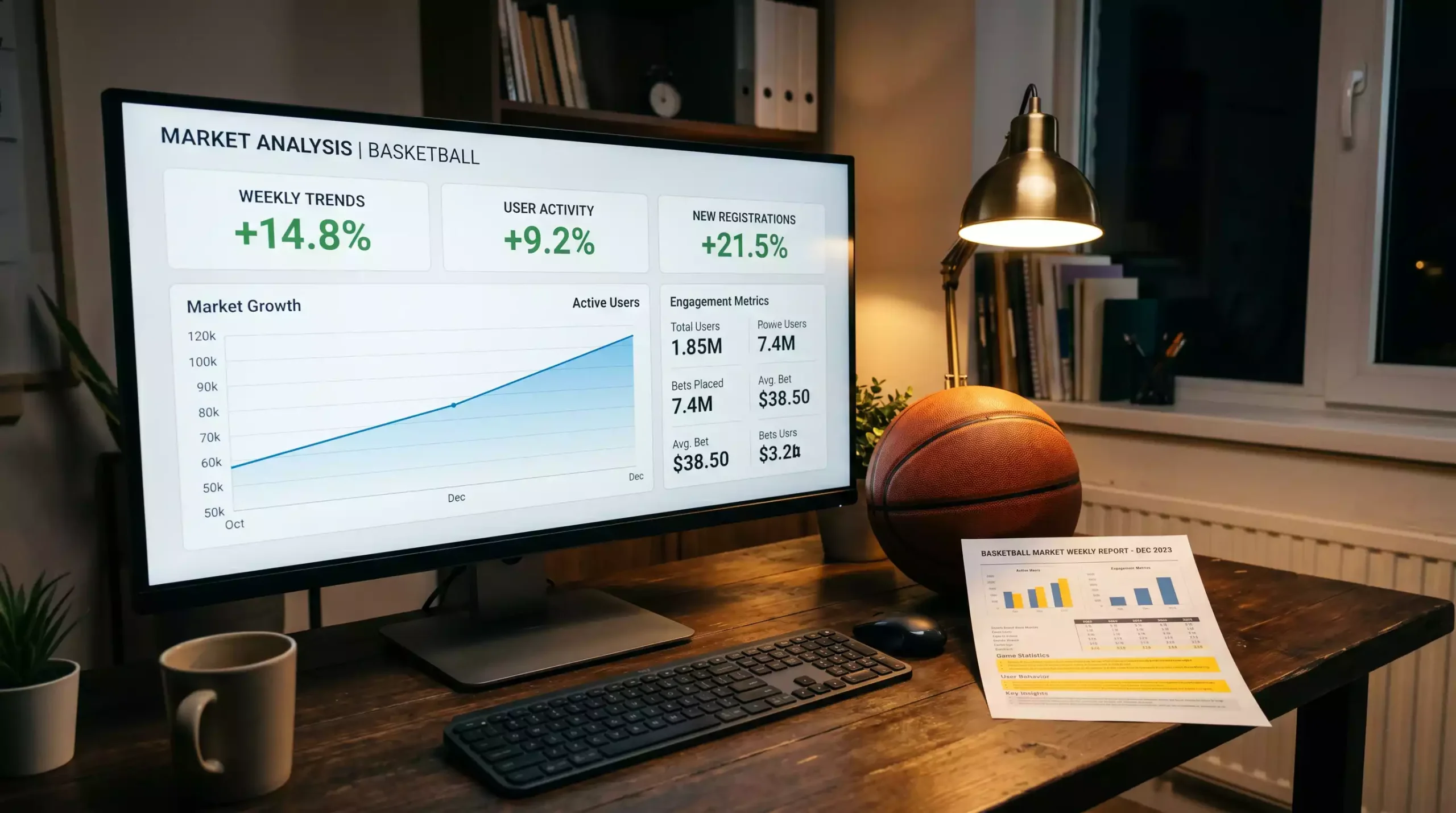
For UK punters, these global numbers matter practically: the depth and liquidity of basketball markets at UK-licensed operators is a direct consequence of the sport's worldwide betting volume. When sixty percent of basketball betting revenue flows through NBA markets, it means tighter margins, more available prop bets, and faster line movement. The market is not abstract. It is the reason your bookmaker offers 200+ markets on a Lakers game but barely ten on a midweek BBL fixture.
Where the UK Fits: GGY, Online Growth, and Mobile Dominance
The UK gambling industry generated a combined gross gambling yield of £16.8 billion between April 2024 and March 2025 — a 7.3% increase year on year. Within that, the remote sector (online casino, betting, and bingo) reached £7.8 billion in GGY, surging 13.1% over the previous year. Those figures cover all sports and all verticals, but they establish the scale of the ecosystem in which basketball betting operates.
How much of that money involves basketball is harder to isolate. The Gambling Commission does not break out GGY by individual sport. What we know is this: 10% of the UK adult population places online sports bets, generating 290.03 million online wagers on real-world events every month. Football claims the largest share — £1.1 billion in GGY — but basketball's portion is growing in line with global trends, driven by the same mobile and live-betting forces reshaping the broader market.
UK Gambling Industry Snapshot
Total GGY: £16.8 billion (April 2024 — March 2025). Remote sector GGY: £7.8 billion, up 13.1% year on year. Monthly online bets on real-world events: 290.03 million. Mobile share of global GGR: 68.4%, with UK punters skewing even more heavily toward mobile than the global average.
The mobile dominance is worth pausing on. Across the industry, 68.4% of gross gaming revenue comes through mobile platforms. In the UK, that percentage is almost certainly higher, given the maturity of the market. For basketball, mobile is not just a convenience — it is the primary interface. NBA games tip off between 11pm and 3am UK time, meaning most basketball bettors in this country are wagering from their phones, between quarters, in bed. The entire user experience — odds comparison, bet placement, cash-out decisions — happens on a screen smaller than a paperback.
This is the context that shapes everything else in this guide. The UK is the most tightly regulated major betting market in the world, operating within the largest regional betting ecosystem, and its punters are increasingly mobile, active in live markets, and interested in sports beyond football. Basketball fits that pattern.
Basketball Betting Markets: From Moneyline to Same Game Parlays
The first time I opened a basketball betting slip at a UK bookmaker, I counted twelve available markets. That was in 2015. Last week, on a regular-season NBA game, I stopped counting at 240. The expansion reflects a shift in how operators structure their basketball offering, driven by the live betting revolution that now accounts for 62.35% of all online sports betting revenue.
Before diving into individual bet types, it helps to draw a line between two categories. Core markets — moneyline, point spread, and totals — are where most of the volume sits and where the sharpest odds appear. Advanced markets — player props, bet builders, and futures — are where operators build their margins and where recreational punters frequently overpay for entertainment value. If you want a deeper breakdown of every market type, I have written a complete guide to basketball betting markets that covers the mechanics in detail.
Core Markets
Moneyline, point spread, totals (over/under). High liquidity, tighter margins, widely available. Best for systematic, data-driven approaches.
Advanced Markets
Player props, bet builders, same game parlays, futures. Lower liquidity, wider margins, more creative combinations. Entertainment value is high; edge is harder to find.
Core Markets: Moneyline, Spread, and Totals
Moneyline — a straight-up bet on which team will win the game, with no point spread involved. The odds reflect each team's implied probability of winning.
The moneyline is the simplest basketball bet you can place: pick the winner. In decimal odds — the default at most UK bookmakers — a favourite might be listed at 1.45 and an underdog at 2.90. Back the underdog with £10 and they win, you receive £29. The maths is transparent and there is no spread to worry about. The trade-off is that backing heavy favourites returns very little relative to risk. A team listed at 1.12 needs to win roughly 89% of the time for the bet to break even, and very few teams maintain that rate over a full season.
Point Spread — a handicap applied to the favoured team to level the betting field. The favourite must win by more than the spread for spread bets on them to pay out.
The point spread is where basketball betting gets interesting. If a team is favoured at -6.5, they need to win by seven or more points for a spread bet to land. Win by six, your bet loses. The half-point eliminates the possibility of a push (a tied outcome against the spread). Spread betting demands a different kind of analysis than moneyline — it is not enough to identify the winner; you need to assess the margin, and margins in basketball are volatile. A team can lead by fifteen at half-time and win by three.
Totals (Over/Under) — a bet on whether the combined score of both teams will finish above or below a line set by the bookmaker.
Totals strip out the question of who wins and focus entirely on pace and scoring. A typical NBA game might carry a total of 224.5 points. You bet over or under that number. The appeal is that you can have an informed view on the game's pace — based on recent form, defensive efficiency ratings, back-to-back scheduling — without needing to predict which team prevails. Totals also tend to be less influenced by public money than spreads, which means the lines can be slightly softer in certain situations.
Example: Reading a Basketball Betting Slip
Suppose Team A is listed at -5.5 on the spread, with a moneyline of 1.55 and a game total of 219.5.
A £20 spread bet on Team A wins if they win by 6+ points. Payout at 1.91 odds: £38.20.
A £20 moneyline bet at 1.55 wins if Team A wins by any margin. Payout: £31.00.
A £20 over bet on 219.5 wins if the combined final score reaches 220+. Payout at 1.91: £38.20.

Advanced Markets: Player Props, Bet Builders, and Futures
Player Props — bets on individual player statistical outcomes (points scored, rebounds, assists) rather than the game result.
Player props are the fastest-growing segment of basketball betting, and also the segment where operator margins tend to be widest. You bet on whether a specific player will go over or under a set statistical line — say, 24.5 points for a star guard. The challenge is that player performance in basketball is highly variable. Matchups, minutes, foul trouble, and blowout dynamics all affect individual stat lines in ways that are difficult to model consistently. Props are entertaining and deepen your engagement with a game, but they are not where you build a long-term edge without significant data work.
Bet builders — sometimes branded as "same game parlays" — allow you to combine multiple selections from the same game into a single wager. You might pair a team's moneyline with a player prop and a quarter result. The odds multiply, producing attractive-looking payouts, but the correlation between legs is where most punters get caught. If you back a team to win and their star player to score over 28.5 points, those outcomes are positively correlated — the true probability of both occurring is higher than the independent multiplication suggests. Bookmakers account for this in their pricing, but not always precisely, and that imprecision occasionally creates value.
Futures markets — betting on season-long outcomes such as the NBA championship winner, conference winners, or MVP awards — operate on a different timescale. They tie up capital for weeks or months, and the odds shift constantly as new information emerges. Futures are worth a small allocation if you have a strong pre-season view, but they are not the core of a serious basketball betting approach.
Markets tell you what you can bet on. The next question is where the volume actually sits — and for basketball, one league dwarfs everything else.
NBA Betting: Why It Dominates the Basketball Handle
I remember the exact moment I understood why NBA betting is different from every other basketball league. It was a Sunday afternoon in 2018, and I was trying to find odds on a EuroLeague quarter-final. My usual bookmaker had four markets. Four. I switched to an NBA regular-season game tipping off that evening and counted 180 markets before I stopped scrolling. The disparity is not accidental — it reflects where the money sits.
The NBA generates approximately 60% of all worldwide basketball betting revenue. The league itself is valued at $12.94 billion in 2025, with forecasts projecting growth to $20.04 billion by 2031 at a CAGR of 7.56%. That valuation is increasingly driven by the league's symbiotic relationship with legal sports betting. The $77 billion media rights deal that launched with the 2025-26 season has turbocharged viewership — early-season average audiences hit roughly 3 million viewers, a 60% jump from the previous year — and viewership directly correlates with betting volume.
NBA Market Value
$12.94 billion in 2025, projected $20.04 billion by 2031
Share of Basketball Betting
~60% of global basketball wagering revenue
Media Rights Deal
$77 billion domestic deal, effective from the 2025-26 season
Viewership Surge
Early 2025-26 season: ~3 million average viewers, up 60% year on year

For UK punters, the NBA's dominance creates both opportunity and constraint. The opportunity is liquidity: because so much money flows through NBA markets, the odds tend to be tighter than in any other basketball league. You will find smaller margins on an NBA moneyline than on a EuroLeague or BBL equivalent. The constraint is timing. NBA games tip off between 11pm and 3:30am UK time during the regular season, which means live betting on the NBA is a late-night activity. That has implications for decision-making that I will address in the strategies section.
Adam Silver, the NBA commissioner, has been unusually candid about the league's position on betting. He has described it as something "people clearly enjoy doing" while placing it "in the category of other things in society that I wouldn't criminalize, but on the other hand that you have to heavily regulate because if there's not guardrails, people will run afoul." That tension — between engagement and regulation — defines the current era of NBA betting. For a deeper look at how NBA odds work and where value appears, see the full NBA betting odds breakdown.
The NBA's total sponsorship revenue exceeds $1.5 billion per season, with casino and betting partners representing one of the fastest-growing categories — up more than 10% year on year before the 2023-24 season.
EuroLeague, BBL, and the Leagues UK Punters Overlook
If you only bet on the NBA, you are ignoring an entire tier of basketball that carries two advantages: earlier tip-off times and thinner markets. The EuroLeague, Turkey's BSL, Spain's ACB, and the British Basketball League (now branded as Super League Basketball) all offer betting opportunities that receive a fraction of the analytical attention directed at the NBA. That asymmetry is where patient punters can find edges that have been arbitraged out of mainstream NBA lines.
The EuroLeague is the most liquid non-NBA basketball market available to UK bookmakers. Games typically tip off between 6pm and 9pm UK time — prime betting hours — and the standard of play is high enough that statistical modelling approaches used for the NBA can be adapted with minor adjustments. Market depth varies by fixture: a Real Madrid vs Olympiacos game might carry 80+ markets, while a mid-table matchup offers 20. The margins are wider than NBA equivalents, but the informational inefficiency can compensate if you are doing your homework.
EuroLeague
Top-tier European club competition. Games at convenient UK hours (6-9pm). Moderate market depth, growing liquidity. Good statistical coverage for modelling.
Super League Basketball
Domestic British league (formerly BBL). Limited market availability, thin odds, minimal analytical coverage. Digital audience growing rapidly — 217% increase in the 2022/23 season.
NCAA / March Madness
US college basketball. Seasonal availability (November-April, peaking in March). High public interest drives line movement. Single-elimination tournament format creates volatility.
Super League Basketball deserves a separate mention, not because the betting markets are deep — they are not — but because the trajectory is worth watching. The league recorded a 217% surge in digital viewership during the 2022/23 season, with play-off audiences jumping 377%. Joe Edwards, the BBL's head of marketing, described it as part of a mission "to make the British Basketball League a household name." Whether that translates into deeper betting markets depends on operator demand. For now, SLB remains a niche market — a handful of operators offer basic moneyline and totals, but player props and in-play options are rare. It is, however, one of the few basketball markets where a UK-based punter can have a genuine informational advantage by attending games and tracking squad changes the broader market overlooks.
In-Play Basketball Betting: 62% of Online Revenue and Climbing
I used to think live betting was for people who could not make up their minds before tip-off. Then I spent a season tracking my in-play results against my pre-game bets, and the data changed my opinion. My pre-game win rate was marginally higher, but my return on investment was better on live bets — the odds were more volatile, and the market was slower to adjust to what I could see on screen than I expected.
The numbers behind in-play betting are staggering. Live wagers now account for 62.35% of all online sports betting revenue globally, growing at a compound annual rate of 13.62% through to 2031. Basketball is one of the sports best suited to in-play markets: four quarters with breaks, constant scoring, frequent lead changes, and tactical adjustments that create identifiable inflection points throughout the game.
Why Basketball Suits In-Play Betting
High scoring frequency creates constant odds movement. Quarter breaks provide natural decision windows. Substitution patterns and foul trouble visibly alter game dynamics. The fast pace means markets reprice every few minutes, offering windows of value that do not exist in lower-scoring sports.

Mobile platforms are the backbone of live betting. For UK punters watching NBA games late at night, the experience is entirely mobile: check the score, assess the flow, place a bet, monitor the cash-out value — all from the same device. The convenience is genuine, but it creates a risk environment that favours impulsive decision-making. Live betting on basketball at 1am, after a couple of drinks, while tired, is one of the most reliable ways to destroy a bankroll. The speed of the game, combined with the ease of placing bets, removes the friction that pre-game betting naturally provides.
In-Play Odds Movement: A Snapshot
Pre-game moneyline: Team A 1.65 / Team B 2.30
End of Q1 (Team B leads by 9): Team A 2.40 / Team B 1.58
Half-time (Team A leads by 2 after a run): Team A 1.72 / Team B 2.15
The same game produced three materially different betting propositions within 24 minutes of play.
The strategic dimensions of in-play basketball betting are substantial enough that I have dedicated a separate guide to in-play basketball betting covering latency, timing, and the tactical reads that translate into live betting edges. What matters here is the structural point: more than six in every ten pounds wagered online on sport now come through live markets, and basketball is one of the sports pushing that ratio higher. If you are not thinking about in-play as part of your approach, you are ignoring the majority of the market.
Data-Driven Strategies: Moving Beyond "Back the Favourite"
Here is the uncomfortable truth about basketball betting strategy: most punters do not have one. They have preferences. They back teams they like, avoid teams they do not, and call it analysis. I know because I did this for the first three years, and I kept meticulous records that proved, in black and white, that my "instincts" were worth approximately minus four percent ROI per season.
The shift from recreational punting to data-driven wagering does not require a statistics degree. It requires three things: a framework for evaluating bets, a method for tracking results, and the discipline to follow both even when they produce uncomfortable conclusions. Basketball is unusually amenable to statistical analysis. Possessions are discrete, outcomes are recorded in granular detail, and the volume of games — 1,230 in an NBA regular season alone — provides a sample size large enough to test hypotheses within a single year.
Strategic basketball betting starts with expected value. Every bet has an implied probability embedded in the odds. If a team is listed at 2.00 on the moneyline, the bookmaker implies a 50% win probability. If your analysis suggests that team wins 55% of the time in that context, the bet has positive expected value: (0.55 x 1.00) - (0.45 x 1.00) = +0.10, or ten pence expected profit per pound wagered. The difficulty is in the assessment, not the arithmetic. Rating your own probability estimates honestly, without anchoring to posted odds, is the hardest skill in sports betting.
Before You Place a Basketball Bet
- Have I assigned my own probability to this outcome, independent of the listed odds?
- Does the implied probability of the odds represent value based on my assessment?
- Have I checked for relevant injury news, rest days, and back-to-back scheduling?
- Am I betting within my pre-set staking plan, or am I chasing a previous loss?
- Can I articulate why I think the market is wrong, in one sentence?
Tracking is non-negotiable. If you are not recording every bet — the market, the odds, your pre-bet reasoning, the result — you are guessing about your own performance. I use a spreadsheet. Some punters use dedicated apps. The format does not matter; the habit does. Over a season, tracked data reveals patterns invisible in the moment: which markets you consistently overvalue, which leagues your analysis performs best in, and whether your in-play bets are subsidising your pre-game profitability or the other way around. I cover specific frameworks in the basketball betting strategies guide, but the foundational principle is this: strategy without data is just opinion with a betting slip attached.
Strategy operates within rules — and in the UK, those rules are changing faster than most punters realise.
UK Regulation and Betting Integrity: What the Industry Won't Tell You
In October 2025, Miami Heat guard Terry Rozier was charged with selling insider information about his own injury status to bettors for $100,000. In the same period, Portland's head coach Chauncey Billups was linked to an illegal poker operation with alleged ties to organised crime. Those were not rumours from a conspiratorial corner of the internet — they were reported by ESPN and documented in federal proceedings. If you bet on basketball and you are not paying attention to integrity, you are ignoring the single largest structural risk in the market.
The UK's regulatory framework for sports betting is built around the Gambling Act 2005 and enforced by the UK Gambling Commission. Marcus Boyle, the Commission's chair, has stated the goal plainly: "a fair, safe, and crime-free gambling market where consumers and the interests of the wider public are protected." That vision is backed by increasing resources — the UK government approved £26 million in additional funding for the Commission over three years to combat illegal gambling.
Betting Integrity Is Not an Abstract Concern
The NBA integrity incidents of 2025 involved players and coaches at the highest level of the sport. While these cases originated in the United States, the odds offered by UK-licensed bookmakers on those same games were directly affected. When insider information enters the market, it distorts lines, and every punter betting against someone with privileged knowledge is operating at a disadvantage they cannot see.
The unlicensed market compounds the problem. The UK's black market for betting swelled to £16.6 billion in 2025 — nearly triple the level recorded in 2019. That money flows through operators not subject to Commission oversight, who do not contribute to responsible gambling funding and do not participate in integrity monitoring agreements with sports leagues. For basketball, the risk is that unlicensed operators can be used to place bets on games where inside information is in play, precisely because those operators lack the surveillance infrastructure that regulated platforms maintain.
Recent Regulatory Developments
Online slot stakes are now capped at £2 per spin for 18-24 year olds and £5 for those aged 25 and over, effective from spring 2025. While this applies to casino products rather than sports betting, it signals the direction of travel: tighter limits, more age-differentiated controls, and a regulatory posture that is becoming more interventionist with each legislative cycle.
Adam Silver himself has argued for tighter oversight, stating that "there should be more regulation" and expressing a preference for federal legislation over the current patchwork of state-by-state rules. The UK already has what Silver is asking for — a national framework with a single regulator — but the framework is only as effective as its enforcement. For UK punters, the practical takeaway is straightforward: bet only with operators licensed by the Gambling Commission, verify that licence, and understand that the full landscape of UK basketball betting regulation extends beyond the operator's homepage reassurances.
Responsible Gambling: Tools, Data, and the GamStop Reality
No guide on basketball betting is complete without addressing the part nobody wants to read. I include it not because regulators require it, but because I have watched people I know lose control of their betting behaviour, and the transition from "recreational punter" to "problem gambler" is quieter and faster than any of them expected.
GamStop, the UK's self-exclusion scheme, has registered more than 562,000 people since its launch in 2018. Over half a million individuals reached a point where they needed to lock themselves out of every licensed operator in the country. The scheme covers all UK-licensed online gambling, including basketball betting, and once activated, it cannot be reversed until the chosen exclusion period expires.
Public sentiment is shifting. A Pew Research Center survey from October 2025 found that 43% of Americans consider legalised sports betting harmful — up from 34% three years earlier. Among men under 30, the figure jumped from 22% to 47%. The UK's regulatory conversation is moving in the same direction.
Tools Available to UK Punters
Every UK-licensed operator is required to offer deposit limits, loss limits, session time limits, cooling-off periods, and self-exclusion options. GamStop provides a single registration point for excluding yourself from all licensed online operators simultaneously. Andrew Rhodes, CEO of the Gambling Commission, has emphasised that the Commission has "tackled some of the critical issues facing operators and consumers" while acknowledging that "the next cycle will involve delivering on some of the key decisions that we and Government have taken." If you feel your betting is becoming difficult to control, these tools exist to be used — not as a last resort, but as a first response.
I track my own betting behaviour with the same rigour I apply to my results. Monthly spend limits, session time caps, and a hard rule against betting on any sport while under the influence of alcohol. Those are not virtuous declarations — they are risk management protocols, no different from the staking plans I use for my bets. The industry will always make it easy to deposit and bet. Making it easy to stop is your responsibility.
How to Start Betting on Basketball in the UK
If you have read this far and you are ready to place your first basketball bet — or restructure how you approach the ones you are already placing — the practical steps are less complicated than the strategic thinking behind them. The UK's regulated framework means the process is standardised across licensed operators, and the barriers to entry are low. That ease of access is why the preparation matters more than the mechanics.
You need to be at least 18 years old — a legal requirement enforced through identity verification that every licensed operator must complete before allowing real-money bets. Across the UK, 47% of adults have participated in some form of gambling, with 15% of men and 4% of women placing sports bets. You are joining a large and established market, and the infrastructure exists to support you — provided you engage with it on your terms.
Getting Started: A Practical Checklist
- Choose an operator licensed by the UK Gambling Commission — verify the licence number on the Commission's public register before depositing
- Set deposit and loss limits during account registration, before your first bet, not after your first bad run
- Start with core markets (moneyline, spread, totals) where margins are tightest and the learning curve is most forgiving
- Open a tracking spreadsheet on day one — record every bet with the date, market, odds, stake, reasoning, and result
- Watch at least five full games before betting on a league to develop a feel for pace, scoring patterns, and in-game dynamics
- Avoid accumulators and bet builders until you have at least three months of tracked single-bet data
The single most important decision is the staking plan you set before you start. Determine a bankroll — an amount you can afford to lose entirely without affecting your financial commitments — and stake a fixed percentage per bet. One to three percent is the range most experienced punters work within. If your bankroll is £500, that means individual bets of £5 to £15. It feels small. It is supposed to. The goal is to survive a losing streak without being forced out of the market, because losing streaks in basketball betting are a mathematical certainty even for profitable punters.
Start with the NBA if you want the deepest markets and tightest odds. Start with the EuroLeague if you want games at convenient UK hours with thinner analytical coverage. Start with Super League Basketball if you want a genuine informational edge and do not mind limited market availability. Whichever league you choose, the approach is the same: watch, record, analyse, adjust. The punters who last in this market are not those who start with the best picks — they are the ones who build systems that improve over time.
Frequently Asked Questions
How do basketball betting odds work in the UK?
UK bookmakers display basketball odds in decimal format by default, though fractional and American formats are usually available in account settings. Decimal odds represent the total payout per pound staked — odds of 2.50 mean a £10 bet returns £25 (£15 profit plus your £10 stake). The odds reflect the bookmaker's assessment of each outcome's probability, with a built-in margin (overround) that ensures the operator profits over time. For a standard NBA game, you will see odds on the moneyline (match winner), point spread, totals, and a range of player and game prop markets.
Is basketball betting legal in the UK?
Betting on basketball is fully legal in the UK when placed with an operator licensed by the UK Gambling Commission under the Gambling Act 2005. All licensed operators must verify your identity, offer responsible gambling tools, and adhere to strict rules around advertising, fair play, and dispute resolution. The key point is the licence: betting with an unlicensed operator is not protected by UK consumer regulations. Always verify an operator's licence status on the Commission's public register before depositing funds.
What types of bets can you place on basketball?
The range depends on the league and operator, but for a typical NBA game you can expect moneyline (match winner), point spread (handicap), totals (over/under combined score), player props (individual statistical lines), quarter and half-time results, first scorer, same game parlays (bet builders), and futures (season-long outcomes such as championship winner or MVP). EuroLeague games carry a similar range at major operators, though market depth is usually shallower. Super League Basketball games may only offer moneyline and basic totals.
Can you bet on the BBL (Super League Basketball) in the UK?
Yes, several UK-licensed bookmakers offer markets on Super League Basketball (formerly the British Basketball League). Coverage varies between operators — some offer moneyline and totals only, while others provide limited spread and half-time markets during play-off fixtures. Market depth is nowhere near NBA or EuroLeague levels, and in-play options are rare. The league's digital audience has grown rapidly (217% increase in the 2022/23 season), which may encourage operators to expand coverage as demand increases.
How is the point spread different from a handicap in basketball?
In practice, they are the same concept with different terminology. The point spread — predominantly used in American markets — and the handicap — the standard term at UK and European bookmakers — both apply a scoring adjustment to the favoured team to balance the betting market. If a team is listed at -6.5 on the spread (or -6.5 on the handicap), they must win by 7 or more points for that bet to land. The distinction is purely linguistic: "spread" is the American term; "handicap" is the British and European equivalent.
How does live (in-play) basketball betting work?
In-play betting allows you to place wagers on a basketball game while it is being played. Odds update continuously based on the score, time remaining, and game flow. You can bet on the next team to score, quarter winners, updated moneylines and spreads, and running totals. The speed of basketball means odds shift rapidly — a ten-point run can invert the moneyline within minutes. Most in-play basketball bets in the UK are placed via mobile apps, and cash-out options allow you to close a bet before the game ends at a price determined by current odds.
What is the best basketball betting strategy for beginners?
Start with a single league, a single core market (moneyline or totals), and a fixed staking plan. Watch games before you bet on them. Track every bet in a spreadsheet with the date, odds, stake, reasoning, and outcome. After 50-100 tracked bets, review your data: which bet types are profitable, which are not, and where your reasoning was consistently wrong. That review process is the strategy. Beginners who chase "winning systems" before building a tracked record almost always lose more than those who start slowly and let their data tell them where to focus.
Articles
Created by the "Betting Basketball UK" editorial team.
